No. 19 - يوليوز (2026)
Here is the English presentation for Issue 19:
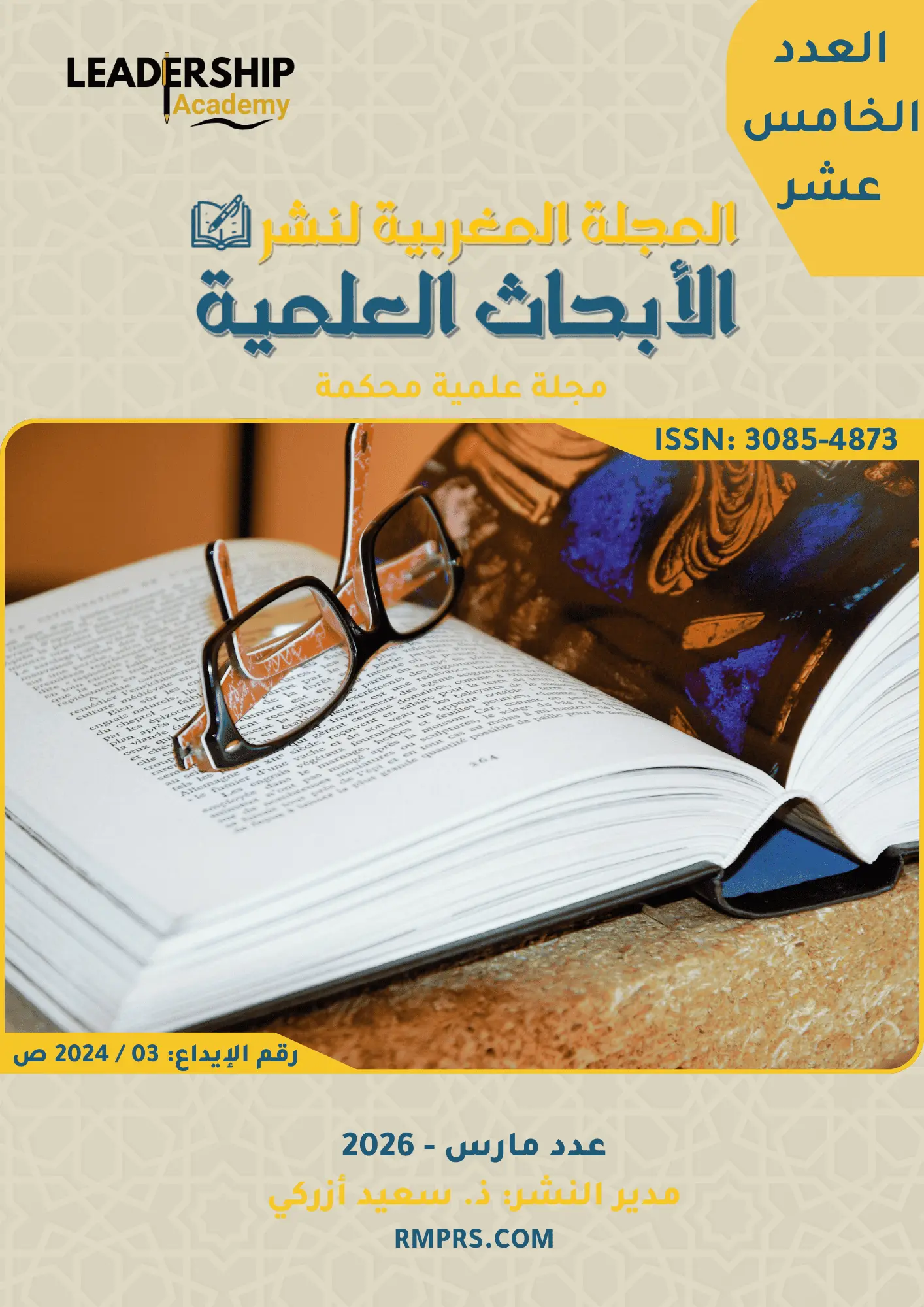
📖 Presentation of the Nineteenth IssueThe Management of the Moroccan Journal of Scientific Research Publishing (RMPRS) is pleased to announce the publication of its Nineteenth Issue, representing a benchmark and an integrated knowledge bridge in the journal’s journey toward establishing rigorous scientific publishing. This issue provides an international, open-access platform that offers all technical facilities for researchers and academics to publish peer-reviewed scientific articles in Arabic, French, and English, ensuring the expansion of knowledge production and achieving tangible scientific and societal impact.
This issue is distinguished by its unique thematic richness and momentum (featuring a total of 35 peer-reviewed articles), critically addressing contemporary developments, current legislative, educational, and social transformations, alongside a profound focus on digitalization, artificial intelligence applications, and sustainable development across various fields of knowledge.
📌 Key Tracks and Research Highlights of Issue 19:-
Islamic and Sharia Studies: Opens the door for academic publishing on authentic heritage and contemporary jurisprudential issues (fiqh al-nawazil). It addresses good treatment from a Quranic perspective, the impact of faith (Iman) according to the Ash'arite school on achieving inner happiness, highlights the methodology of Hadith scholars in dealing with controversial narrators, examines the historical jurisprudence of disagreement within the Maliki school of thought, and explores the concept of Haml (carrying meaning) in the principles of Quranic text interpretation.
-
Legal and Political Studies: Offers a robust collection of research examining legislative transformations in public and private law. Topics range from the mandatory will (Wasiya Wajiba) in the Moroccan Family Code, the jurisprudential and legal adaptation of the Salam contract upon non-delivery, the evidentiary value of DNA profiling, to women's legal empowerment against climate change in Morocco, electronic litigation and digital justice in Sudan, digital communication in Moroccan public administration, and the role of Moroccan cultural diplomacy supporting the causes of Jerusalem and the Moroccan Sahara internationally.
-
Educational Sciences, Training, and Didactics: A vital track engaging researchers in curriculum development and educational psychology. It analyzes inclusive education practices for children with disabilities and their field implementation challenges, pedagogical guides for teaching Arabic prosody (Arūd), bridging the gap between theoretical knowledge and professional practice, school violence in upper secondary education, the role of health education in safe learning environments, and Islamic perspectives on contemporary educational issues.
-
Humanities and Social Sciences: Delivers in-depth sociological, anthropological, and geographical analyses. Studies explore the dynamics of marriage reluctance through a psycho-sociological lens, socio-anthropological approaches to water resource management (Souss region as a case study), and geomorphological assessments of natural vulnerability and water erosion dynamics in semi-arid zones.
-
Literature, Language, and Criticism: Dedicated to Arabic textual aesthetics and linguistic criticism. Highlights include the semantic inimitability (I'jaz) of metaphoric imagery in the Quran through analytical rhetorical study, alongside analyzing the categorical nature of the active participle (Ism al-Fa'il) in Arabic grammar.
-
Linguistics, Philosophy, and Cultural Studies: Presents profound intellectual and cultural research examining the critique of humanism and metaphysical fulfillment in René Guénon’s hermeneutics, as well as deconstructing value formation in consumer advertising imagery within the Moroccan context via a semiotic-pragmatic approach.
-
International Studies in Foreign Languages (FR / EN): Features a rich international section comprising 9 research papers in French and English. Topics cover human rights and migration under international law, Morocco’s energy and institutional transition, cultural diplomacy, the digital fracture as a structural barrier to youth employability, higher education students' acceptance of AI-based virtual tutors, conversational AI in FLE (French as a Foreign Language) classrooms, socio-spatial marginalities in urban relocation projects (Salé), the historical role of Alliance Israélite Universelle female teachers, and the contemporary trajectories of the Spanish language in Morocco.
🎯 Why Choose Our Journal for Scientific Publishing? The journal is committed to enhancing scientific quality, guaranteeing rapid indexing and broad international reach for published research, thereby providing a continuously renewed reference material for researchers across global universities.
We welcome your contributions and academic studies (theoretical and empirical) for inclusion in upcoming issues. You can communicate directly with the journal’s scientific management and submit your research via:
-
Email: ContactRMPRS@gmail.com
-
WhatsApp / Phone: +212 716-288654